Most urgent care leaders can tell you how many X-rays their clinics perform each month. Far fewer can tell you who ultimately interprets those images, how often radiologist overreads occur, or what happens when a second opinion identifies something different.
That gap matters.
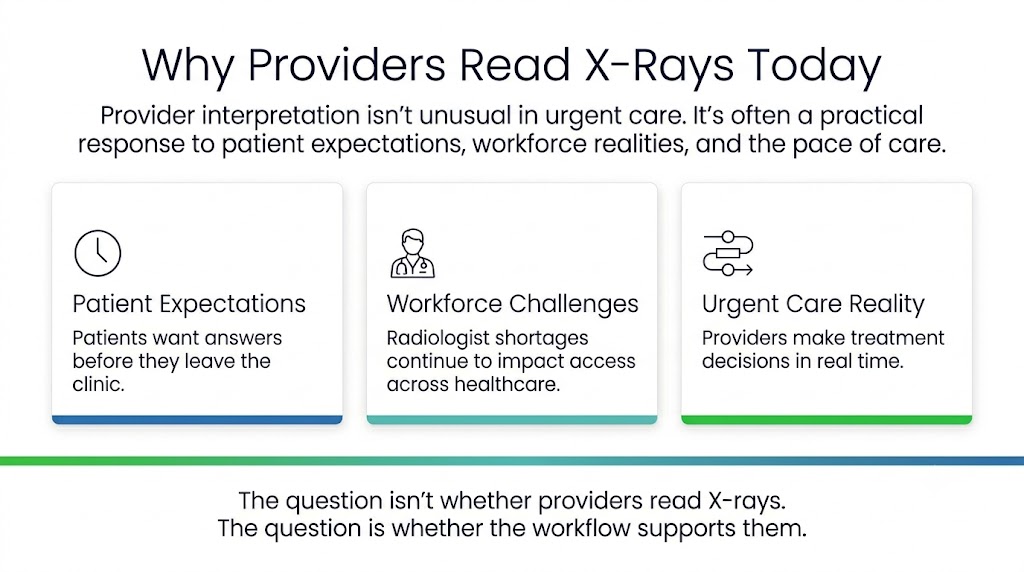
In urgent care, providers read X-rays every day. They have to. Patients need answers, treatment decisions can’t wait, and a radiologist isn’t always available in the moment.
That’s become even more common as imaging volumes rise and healthcare organizations navigate ongoing radiologist shortages. The reality is that provider interpretation is now a routine part of many urgent care workflows.
The question isn’t whether that should happen. The question is whether the process surrounding those reads is built to support accuracy, quality, and patient safety.
As imaging demand continues to grow, now is a good time for urgent care leaders to ask: Does our imaging workflow support both speed and accuracy?
Why Self-Interpretation Has Become So Common
In urgent care, waiting hours for an imaging interpretation often isn’t an option. Providers need to make treatment decisions while the patient is still in the clinic, which means an initial read of the X-ray is frequently part of the visit.
That reality isn’t unique to urgent care. Research published in the American Journal of Roentgenology found that a significant percentage of office-based imaging studies are interpreted by the ordering provider rather than a radiologist. Across healthcare, providers are often making decisions based on their own interpretation of an image.
At the same time, access to radiologists is becoming more challenging. Researchers project that imaging demand will continue to outpace radiologist workforce growth for decades to come, creating additional pressure on organizations that rely on timely imaging interpretations.
None of this means providers shouldn’t perform initial reads. In many cases, they have to. The more important question is whether those reads are supported by a process that includes quality checks, radiologist oversight, and a clear path for identifying discrepancies when they occur.
This Isn’t a Provider Problem. It’s a System Problem
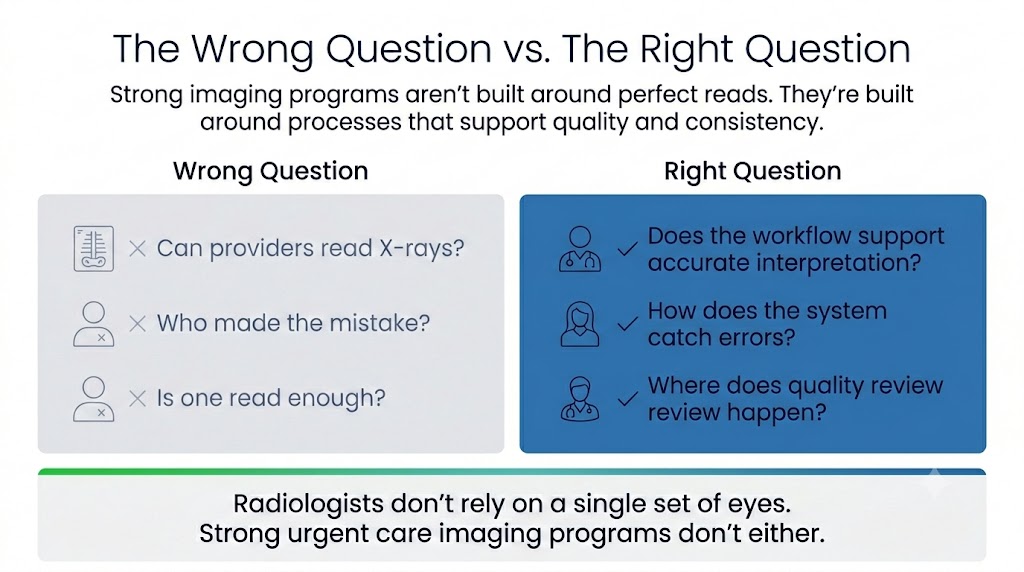
Discussions about imaging interpretation can sometimes become framed as a question of individual capability. That’s the wrong lens.
Urgent care providers make thousands of clinical decisions every year. Reading an X-ray is just one piece of a much larger patient assessment, and those decisions are often made under significant time pressure.
The real question isn’t whether providers can read X-rays. It’s whether the organization has built a process that helps catch the findings that any busy clinician might miss.
Radiologists don’t rely on a single set of eyes, and neither should urgent care organizations. Peer review, second reads, quality assurance programs, and discrepancy tracking all exist for the same reason: to improve accuracy and strengthen patient care.
The same principle applies to urgent care imaging programs.
What Happens When a Second Read Occurs
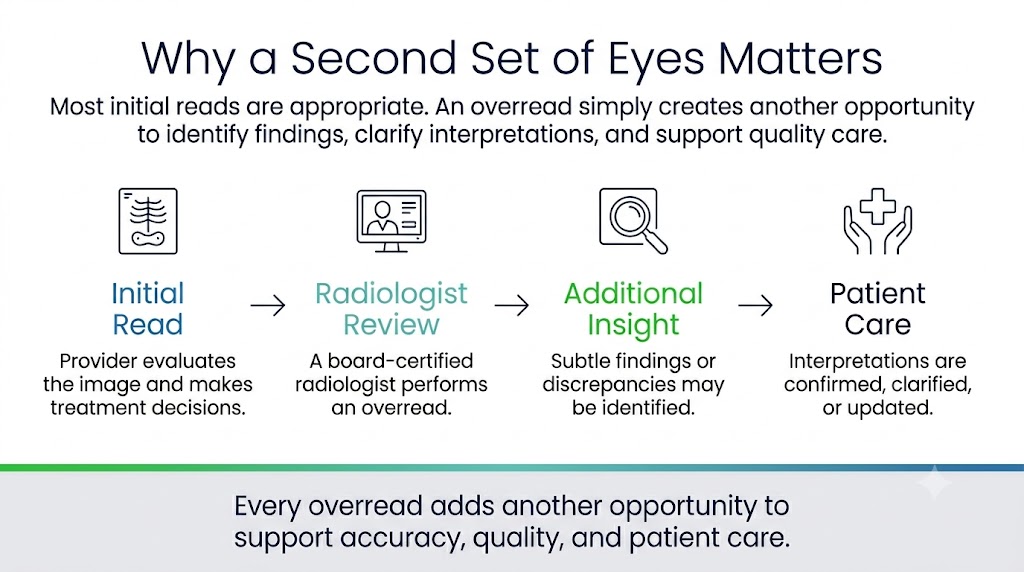
Every healthcare organization wants to get the diagnosis right the first time. But one of the reasons overreads are valuable is that they acknowledge a simple reality: a second set of eyes can be helpful.
Research examining double-reading and overread programs has found that clinically meaningful discrepancies are identified with enough frequency to influence patient management, follow-up recommendations, and treatment decisions.
In some cases, those differences can change what happens next for the patient. Research published in the Journal of the American College of Radiology found that discrepancies identified between initial interpretations and radiologist reviews frequently resulted in changes to patient care.
That’s not an indictment of the initial read. It’s a reminder that medicine works best when important decisions have multiple opportunities for review. Overreads help provide that extra layer of validation, helping organizations strengthen quality while supporting the providers making real-time decisions every day.
For urgent care leaders, that’s one of the strongest arguments for building overreads into the imaging workflow.
The Hidden Value of an Overread
When urgent care leaders evaluate imaging programs, turnaround times tend to get most of the attention. Faster reads, shorter patient visits, and operational efficiency are all important.
But speed is only part of the story.
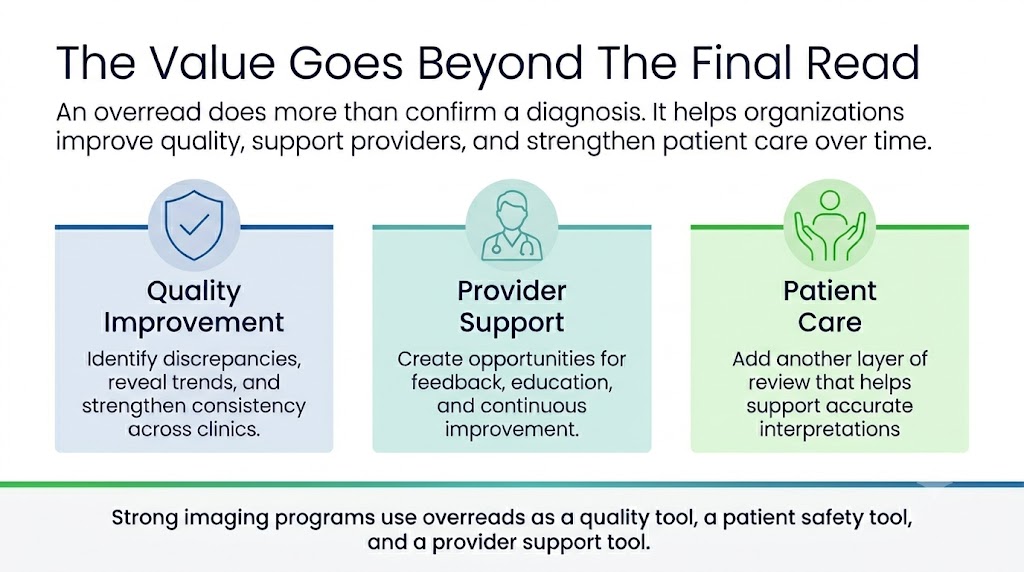
A radiologist overread does more than provide a final interpretation. It creates another opportunity to validate findings, identify discrepancies, and ensure nothing important slips through the cracks. Over time, those reviews can also reveal patterns, helping organizations understand where additional training, workflow improvements, or quality initiatives may be needed.
Beyond quality and patient safety, overreads can also help organizations create a more defensible imaging workflow by ensuring a board-certified radiologist participates in the interpretation process.
Perhaps most importantly, overreads create a feedback loop. Instead of simply moving from one patient to the next, organizations gain visibility into how imaging is being interpreted across providers, clinics, and patient populations.
That’s why the strongest imaging programs don’t view overreads as a compliance checkbox. They view them as a tool for improving quality, supporting providers, and strengthening patient care.
What Urgent Care Leaders Should Review Right Now
Most imaging programs don’t stay the same for long.
New providers join the team. Volumes increase. Workflows evolve. New technologies are introduced. Over time, small changes can add up, making it difficult to know whether the imaging process that worked three years ago is still working today.
That’s why it’s worth stepping back and taking a fresh look at the fundamentals.
Ask yourself:
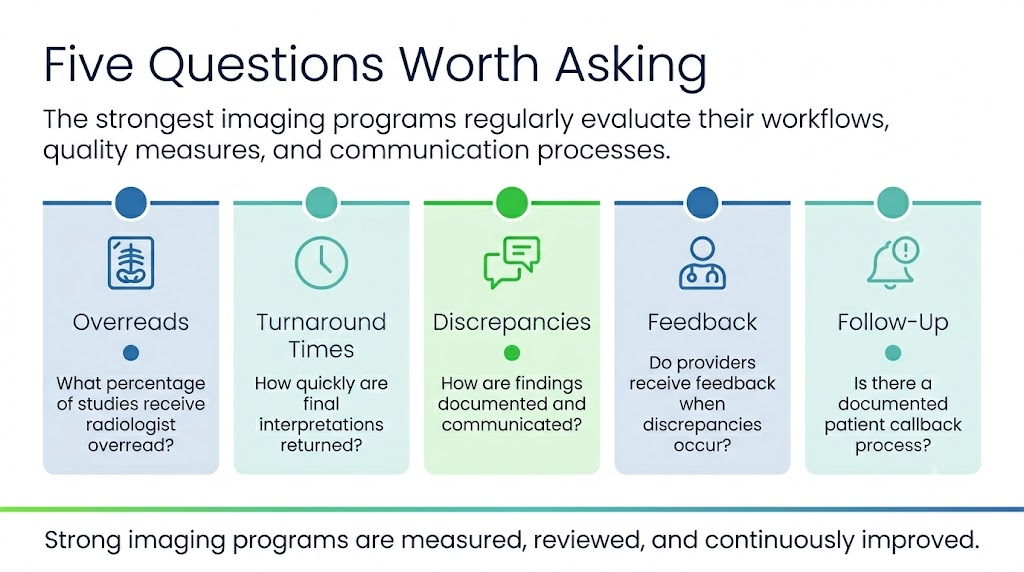
- What percentage of imaging studies receive radiologist overread?
- How quickly are final interpretations returned?
- How are discrepancies documented and communicated?
- What happens when a radiologist identifies a finding that differs from the initial interpretation?
- Are imaging quality metrics reviewed regularly?
- Do providers receive feedback when discrepancies occur?
- Is there a documented patient callback process?
These questions aren’t just about compliance. They help reveal whether imaging is being managed as a coordinated quality program or simply a series of disconnected tasks.
Building a More Defensible Imaging Program
As imaging volumes continue to grow, urgent care organizations will face increasing pressure to balance speed, quality, and patient safety.
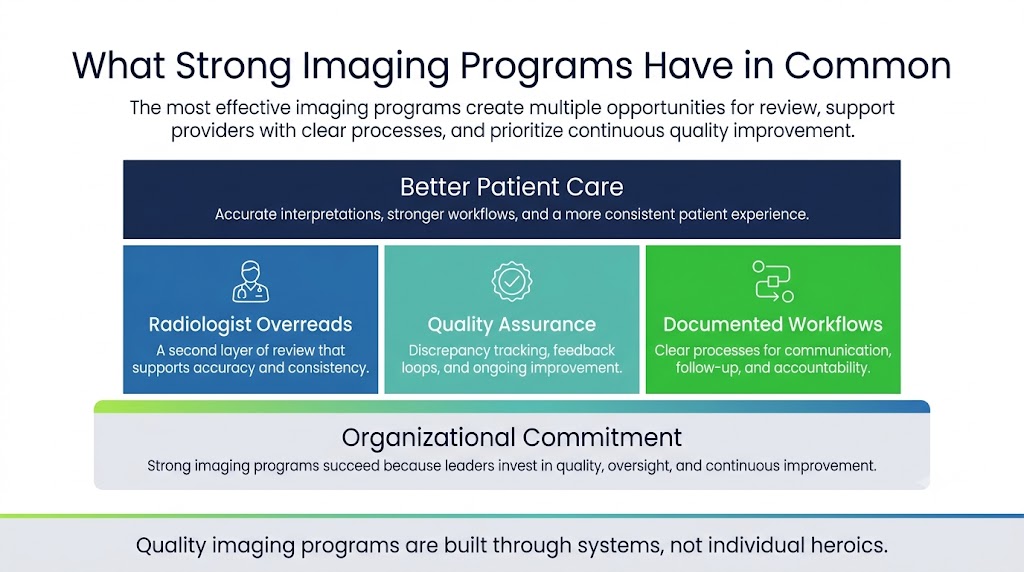
The good news is that building a stronger imaging program doesn’t necessarily require more staff, more technology, or a complete operational overhaul. Often, it starts with creating more opportunities for review, establishing clear accountability, and making sure providers have the support they need when interpreting images.
Overreads are part of that equation, but they’re not the whole picture. Quality assurance programs, discrepancy tracking, documented workflows, and reliable access to radiologists all contribute to a stronger foundation.
No imaging program can eliminate risk entirely. Healthcare is simply too complex for that.
What organizations can do is build systems that help catch issues earlier, support better decision-making, and create a more consistent experience for both providers and patients. That’s ultimately what separates a good imaging workflow from a great one.
Build a More Confident Imaging Workflow
Every imaging program depends on more than speed alone. Experity Teleradiology combines rapid turnaround times, radiologist overreads, and AI-assisted workflows to help urgent care organizations strengthen quality, support providers, and deliver a better patient experience.