Pillar 4: Continuity
An imaging report can be technically perfect and still fail the patient.
The interpretation may be accurate. The radiologist may identify the correct finding. The report may arrive exactly when expected. Yet none of those things guarantee that the patient received the information, understood what it meant, or took the appropriate next step in their care.
Imaging often creates responsibilities that extend beyond the visit itself. Not every final interpretation is available before discharge. Some reports identify findings that change the original assessment. Others recommend additional imaging, specialist referral, or follow-up treatment after the patient has already left the clinic. Once new information becomes available, the quality of the interpretation is only one part of the equation. The organization must still ensure that the information reaches the right people and leads to the appropriate action.
A finding documented in a report still depends on people, systems, and workflows to ensure it reaches the patient and results in meaningful action. Recommendations that never reach patients cannot improve care. Referrals that are never completed cannot advance treatment.
That is why Continuity is one of the Five Pillars of Imaging Excellence. Imaging only delivers its full value when organizations consistently close the loop between interpretation and patient care.
The Report Is Complete. The Care May Not Be.
Healthcare organizations are remarkably good at producing information. Reports are generated, findings are documented, and recommendations become part of the medical record within well-defined clinical workflows. Those activities are essential, but they are also internal measures of success. They tell leaders that information exists, not that it changed anything.
Continuity focuses on the outcome of that information. Did it influence patient care? Did it reach the right person? Did it produce the action the organization intended?
That distinction is easy to overlook because documentation creates a natural sense of completion. Once a report is signed, it feels as though the work has been finished. Operationally, however, the report often represents the beginning of another phase of care. New information must move beyond the medical record, reach the people responsible for acting on it, and ultimately influence what happens next for the patient.
Organizations that consistently accomplish that transition are not simply managing follow-up. They are extending the value of imaging beyond interpretation.
Closing the Loop Is Different Than Completing a Task
Many continuity programs are evaluated through activity. Was the patient contacted? Was the chart updated? Was a callback documented?
Those measures are useful, but they can create a false sense of confidence because they describe whether work occurred rather than whether the objective was achieved.
Closing the loop requires something more comprehensive. It asks whether clinically significant information completed its journey from discovery to action.
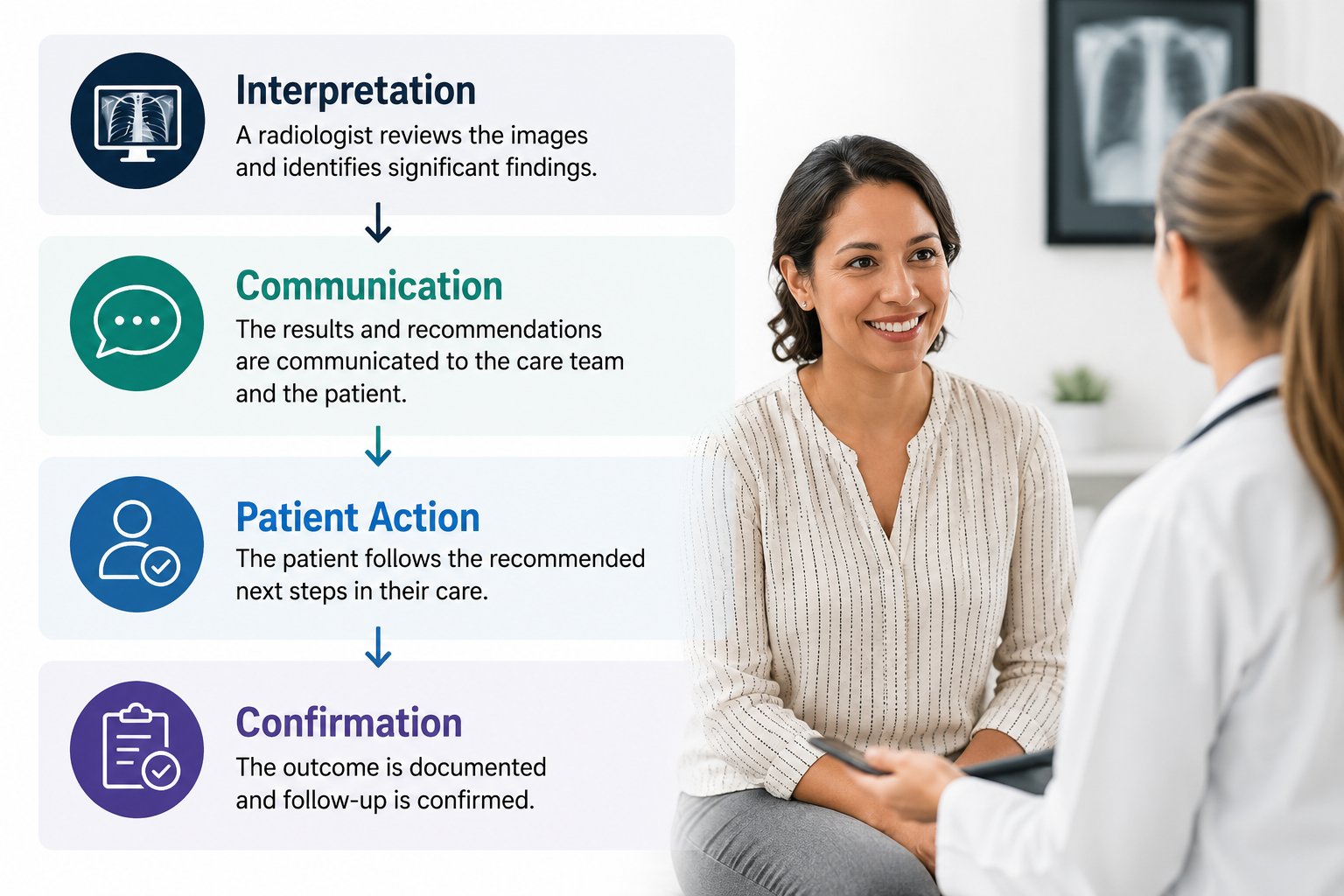
Each stage depends on the one before it. An accurate interpretation has little value if communication fails. Communication alone accomplishes little if recommended care never occurs. Confirmation provides assurance that the information produced the outcome the organization intended.
Viewed this way, continuity becomes an operational capability rather than an administrative process. The objective is not simply to complete individual tasks. It is to ensure that important clinical information reliably progresses from one stage to the next.
Patients Judge the Entire Journey
Patients rarely distinguish between the teams involved in imaging. They do not think about radiologists, providers, nurses, or front-office staff as separate parts of a workflow. They experience a single organization that either communicates clearly or does not, follows through consistently or does not, and provides confidence or uncertainty about what should happen next.
A patient who receives timely, understandable guidance after new information emerges is likely to view the experience as coordinated and trustworthy. A patient who receives conflicting information, delayed communication, or unclear next steps often perceives the entire episode of care differently, even when the interpretation itself was accurate.
For leaders, continuity is as much about consistency of experience as it is about consistency of operations.
Continuity Is a Leadership Discipline
As urgent care organizations expand, continuity becomes increasingly difficult to sustain through personal oversight alone. Leaders cannot depend on individual memory, informal communication, or local habits to ensure every important finding reaches the appropriate conclusion.
The organizations that perform well over time establish continuity as a measurable operational capability. Expectations are standardized, accountability is visible, and leaders understand where variation exists before it affects patients. Rather than asking whether staff completed individual follow-up activities, they evaluate whether the organization consistently delivers on the promise made when imaging was ordered in the first place.
That perspective elevates continuity from an operational responsibility to a strategic advantage. Reliable follow-up strengthens patient confidence, supports providers, and gives leadership greater assurance that important findings become meaningful action regardless of where or when care is delivered.
The Final Measure of Imaging Excellence
An imaging report is complete when it is signed. Patient care is complete when the information has reached the right person, informed the right decision, and supported the right next step.
That distinction defines Continuity within the Five Pillars of Imaging Excellence. The strongest imaging programs recognize that interpretation alone does not improve outcomes. Information creates value only when it moves through the organization and ultimately reaches the patient in a way that changes care.
Organizations that consistently close that loop do more than complete imaging workflows. They deliver on the purpose of imaging itself.
How Strong Is Your Imaging Continuity?
Learn how Experity Teleradiology helps urgent care organizations strengthen continuity through dependable communication, collaborative workflows, and reliable processes that help ensure clinically important findings lead to timely patient action.