Pillar 3: Quality
Most urgent care leaders understand why overreads matter. They provide an additional layer of review, help identify discrepancies, and support more confident decision-making when providers are managing patients quickly. In a busy urgent care setting, that kind of clinical support is valuable on its own.
The more strategic question is what happens after the overread is complete.
In many organizations, quality review is treated as a way to resolve the case in front of the team. A discrepancy is identified, the chart is updated, the provider is notified, and the patient receives appropriate follow-up. That process matters, especially when findings change the care plan. But if the organization stops there, it may miss the larger opportunity.
Every overread contains information about how the imaging program is functioning. Some cases may reveal a documentation gap. Others may point to a need for more clinical context, clearer communication between providers and radiologists, or additional education around certain injury patterns. Over time, individual cases can begin to show patterns that help leaders strengthen the entire imaging workflow.
That is where quality becomes more than a review process. It becomes a learning system.
A Corrected Report Should Not Be the End of the Story
Quality assurance often looks backward by design. It examines what happened, whether the interpretation was accurate, and whether the final report changed the patient’s care. That retrospective view is important because discrepancies can have real clinical consequences. In a Journal of the American College of Radiology study of major discordances between preliminary and final radiology reports, 52 of 199 cases, or 26%, resulted in a management change, reinforcing that report differences can affect what happens next for patients (jacr.org).
For urgent care organizations, the lesson is not simply that discrepancies occur. The more useful insight is that discrepancies create moments of visibility. They show where provider interpretation, radiologist review, clinical context, documentation, and follow-up processes intersect. When those moments are handled only as case corrections, the organization may resolve the immediate concern without learning how to reduce similar issues in the future.
A more mature imaging program treats each discrepancy as a signal. The goal is still to support the patient in front of the care team, but the process also asks what the case reveals about the broader system. Did the provider have enough information at the point of care? Did the radiologist receive the clinical history needed to interpret the image in context? Was the discrepancy communicated quickly and clearly? Did the follow-up process work the way leadership expected?
Those questions move quality review from a retrospective activity into an improvement process. The case may close, but the learning should continue.
Quality Improves When Feedback Moves in More Than One Direction
Strong imaging quality depends on collaboration between the people who see the patient and the people who interpret the image. Providers bring the patient’s history, physical exam, symptoms, and clinical judgment. Radiologists bring specialized expertise in image interpretation. The best quality programs create reliable ways for those perspectives to inform each other.
That collaboration requires more than final reports. Providers benefit from understanding why an interpretation changed or why a finding may have been subtle. Radiologists benefit from meaningful clinical context, especially when imaging findings need to be understood alongside the patient’s presentation. Leaders benefit when those exchanges produce insight they can use to improve documentation, ordering practices, education, and workflow design.
The American College of Radiology’s practice parameter for communication of diagnostic imaging findings emphasizes the importance of communication beyond the final report, including preliminary reports, nonroutine communications, and informal communications. For urgent care organizations, that matters because many imaging challenges are not strictly interpretive. They involve the handoff between clinical assessment, radiology interpretation, patient communication, and follow-up (gravitas.acr.org).
A provider questioning a read should not have to wonder whether the concern reached the right person. A radiologist requesting more context should not depend on informal channels that vary by clinic or provider. Quality improves when communication pathways are clear enough to support collaboration during the case and learning after the case.
Patterns Matter More Than Isolated Events
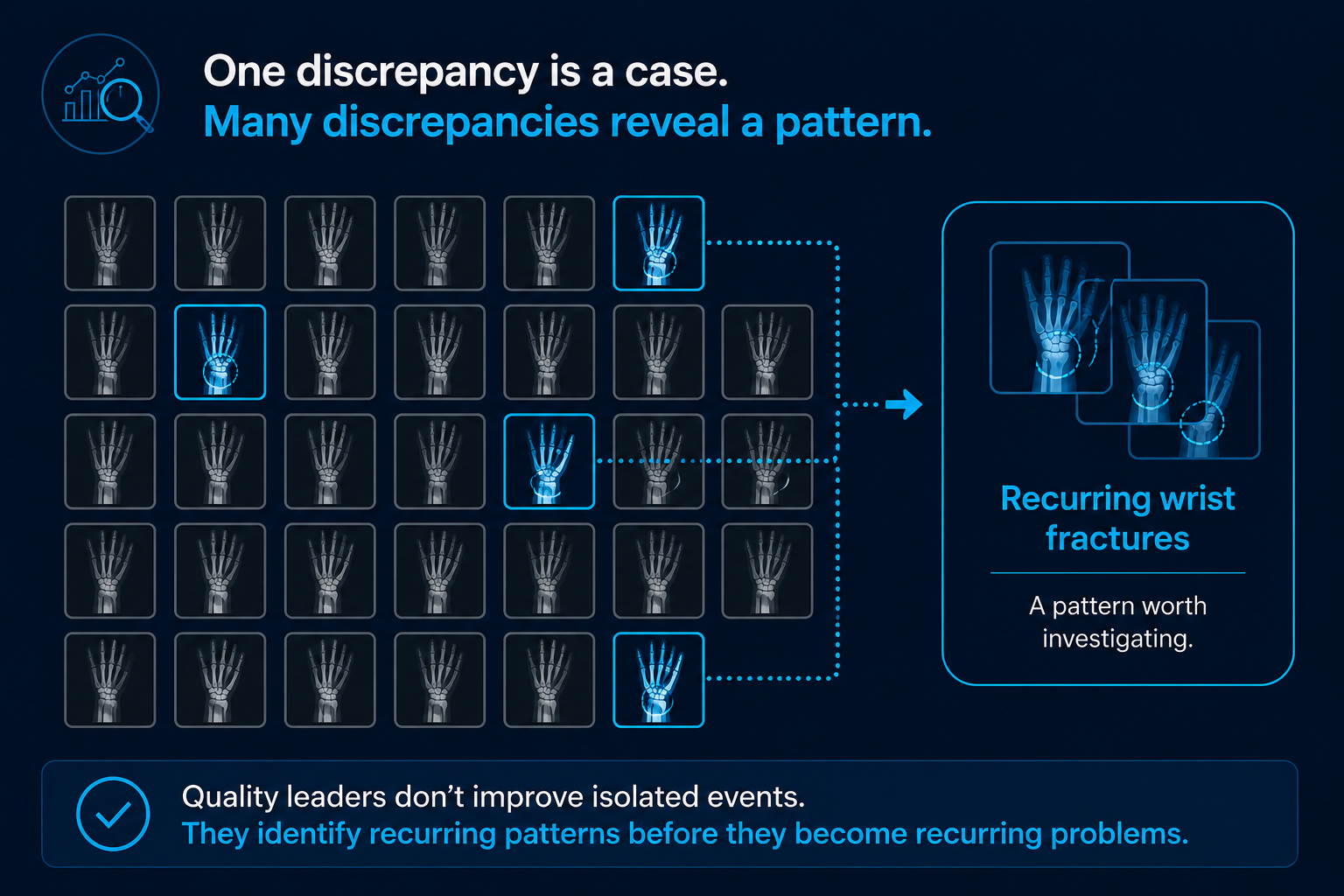
Individual discrepancies deserve attention, but patterns are what help leaders understand whether the imaging program is improving. One missed finding may reflect a complex case. Several similar findings may suggest a training opportunity, a documentation issue, or a workflow problem affecting multiple locations.
That distinction is critical for urgent care leaders because imaging quality can be difficult to evaluate from case volume alone. A program may feel stable because discrepancies are uncommon, yet still miss opportunities to improve if no one is looking across cases for recurring themes. The value of structured review is that it helps leadership separate isolated events from system behavior.
The radiology field has increasingly recognized the value of learning-focused approaches. The American College of Radiology describes peer learning as a way to support Just Culture, error analysis, prevention, and continuous quality improvement rather than relying on punitive approaches that discourage reporting and discussion. A 2023 Journal of the American College of Radiology survey found that among ACR respondents using peer learning, 89% felt it supported an improved culture of safety and wellness, and 86% said it fostered continuous improvement initiatives (acr.org, jacr.org).
Urgent care is not a hospital radiology department, and its quality programs do not need to look identical. But the principle still applies. When teams can discuss difficult cases in a way that focuses on learning, the organization gains a clearer picture of where to improve. The point is not to turn every discrepancy into a formal committee review. The point is to make sure meaningful lessons do not remain trapped inside individual cases.
Quality Data Should Help Leaders Decide What to Improve Next
Many organizations track quality because they need to know how the program is performing. That information is useful, but quality data becomes more valuable when it helps leaders decide where to focus next.
Discrepancy rates, addenda, overread outcomes, communication delays, and follow-up trends can all point toward different improvement opportunities. Repeated issues with certain study types may suggest a need for provider education. Missing clinical history may indicate documentation or ordering workflow gaps. Delays in communicating changed findings may reveal problems in the follow-up process. Variation across locations may suggest that standards are not being executed consistently.
Those insights matter because quality improvement is never only a clinical exercise. It is also operational. A mature imaging program gives leaders enough visibility to understand where quality is being supported by the workflow and where quality still depends too heavily on individual effort.
A Better Question for Quality Leaders
Many organizations ask whether their imaging program is accurate, and they should. Accuracy will always be central to imaging quality. But accuracy alone does not tell leaders whether the program is getting stronger over time.
A more useful set of questions looks beyond individual reports and examines whether the organization is learning from the work it already does every day:
- Are discrepancies reviewed for broader patterns, or resolved only case by case?
- Do providers receive meaningful feedback from overreads?
- Do radiologists receive enough clinical context to support high-quality interpretations?
- Are recurring findings used to guide provider education?
- Are communication gaps identified and addressed across the workflow?
- Are lessons from one clinic shared with other locations?
- Does quality review lead to measurable workflow improvement?
These questions help leaders evaluate whether quality is functioning as an improvement engine or simply a retrospective checkpoint.
Quality Review Should Make the Next Case Stronger
The strongest imaging programs do more than identify what happened in the last case. They use that information to improve the next one.
That distinction matters for urgent care organizations because providers are making decisions quickly, patients expect answers during the visit, and every imaging workflow depends on coordination between clinical teams, radiologists, staff, and follow-up processes. A corrected report can help one patient. A learning process can improve care for every patient who follows.
Quality becomes more powerful when it is treated as part of everyday operations rather than an occasional review activity. Overreads, discrepancies, clinical questions, documentation improvements, and provider feedback all become part of the same goal: building an imaging program that gets stronger with experience.
That is why Quality is one of the Five Pillars of Imaging Excellence. It is not only about measuring performance after the fact. It is about creating a system that learns continuously, supports providers more effectively, and gives leaders clearer insight into where improvement will have the greatest impact.
How Does Your Organization Learn From Every Overread?
Discover how Experity Teleradiology helps urgent care organizations strengthen imaging quality through collaborative review, consistent workflows, and continuous learning.