
AI, X-Rays, and Liability: The New Questions Urgent Care Leaders Need to Ask
06/16/2026
Artificial intelligence is rapidly changing radiology, but the conversation has evolved beyond whether AI works. Today, healthcare leaders are asking more practical questions. How should AI fit into imaging workflows? What role should providers, radiologists, and technology each play in the interpretation process? And how does liability change when technology becomes part of the diagnostic process?
These questions are becoming increasingly important for urgent care operators. Imaging volume continues to rise, radiology staffing remains challenging in many markets, and new AI-enabled tools are entering clinical workflows at an unprecedented pace. At the same time, providers and organizations remain responsible for ensuring patient safety and maintaining appropriate standards of care.
The future of radiology is unlikely to be defined by AI replacing clinicians. Instead, it will be shaped by how organizations combine technology, clinical expertise, and workflow design to deliver safe, efficient, and defensible care.
AI Has Become a Major Force in Radiology
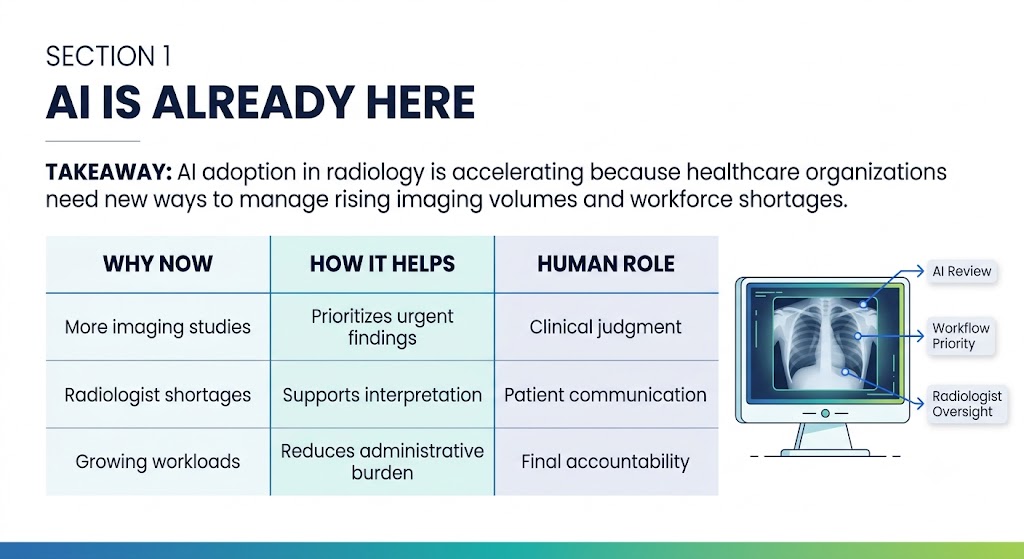
While AI applications are emerging throughout medicine, radiology has quickly become the leading specialty for adoption. According to the U.S. Food and Drug Administration (FDA,) radiology accounts for the largest share of AI-enabled medical devices that have received regulatory clearance. Industry analyses further estimate that more than 75% of FDA-cleared AI-enabled devices are related to radiology and medical imaging, highlighting how quickly the specialty has embraced AI-driven innovation.
This growth is driven by practical needs. Imaging volumes continue to rise while healthcare organizations face ongoing workforce challenges. A recent global survey of radiologists found that staffing shortages and growing workloads remain among the profession’s most significant concerns, creating pressure to find solutions that improve efficiency without sacrificing quality.
As a result, AI is increasingly being used to support image interpretation, identify potentially urgent findings, prioritize worklists, and reduce administrative burden. Rather than functioning as autonomous readers, most deployed tools serve as clinical support systems that help radiologists and providers work more effectively (JACR.)
The Technology is Advancing, but Workflow Remains the Deciding Factor
Much of the conversation surrounding AI focuses on performance. Can a tool detect a fracture? Can it identify an abnormal chest X-ray? Can it improve diagnostic accuracy?
Those questions matter, but they only tell part of the story.
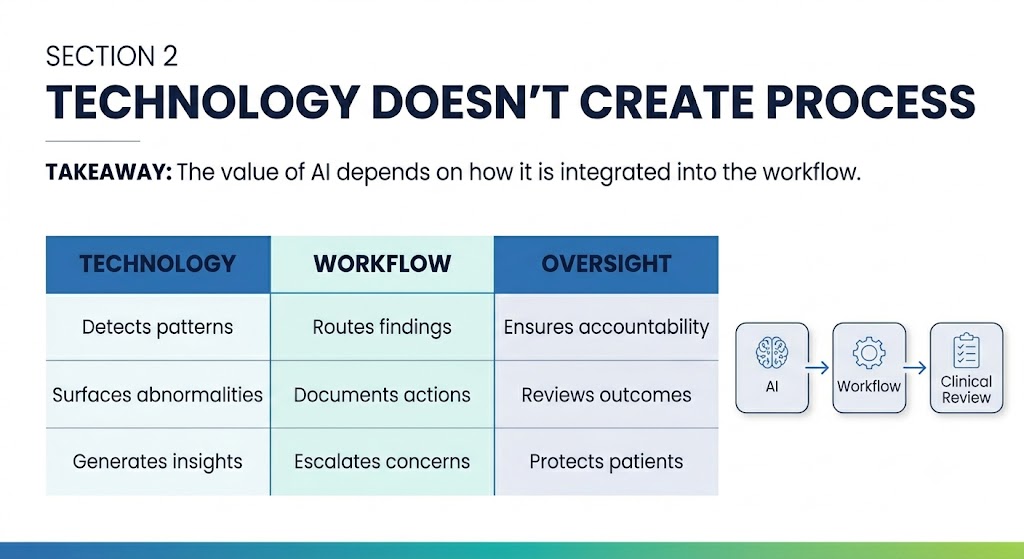
Healthcare organizations do not implement AI in a vacuum. Technology becomes part of a larger clinical process that includes providers, radiologists, documentation systems, quality programs, and patient communication workflows. Even highly capable technology can introduce challenges when there is uncertainty around how findings are reviewed, documented, escalated, or communicated.
Researchers studying AI deployment in healthcare have found that organizations often move faster on adoption than governance, creating gaps in oversight, accountability, and workflow management. In other words, the value of AI often depends less on the technology itself and more on how organizations choose to use it.
For urgent care operators, that means thinking beyond software features and considering broader operational questions. Who reviews AI-generated findings? What happens when technology identifies something a provider did not initially see? How are discrepancies tracked? When does a radiologist become involved?
Organizations that answer those questions proactively are more likely to improve outcomes while avoiding unintended risk.
The Future is Not AI Versus Radiologists
Much of the public conversation surrounding AI in healthcare has been framed as a competition between technology and clinicians. Headlines frequently speculate about whether AI will replace radiologists or eliminate the need for human interpretation.
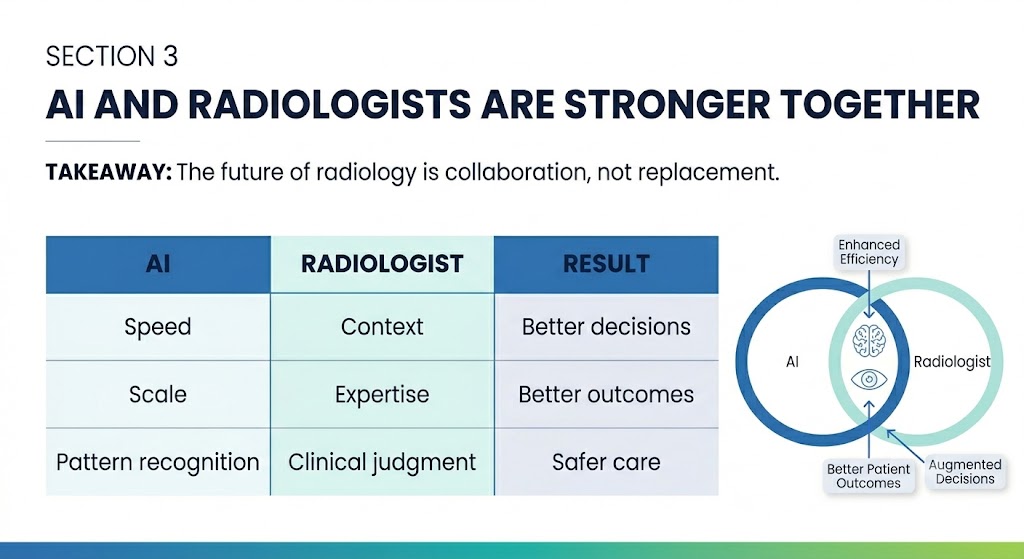
The reality emerging from clinical practice looks very different. Surveys of practicing radiologists continue to show that most clinicians view AI as a tool for augmenting human expertise rather than replacing it. AI can help identify studies that need immediate attention, reduce repetitive tasks, and improve workflow efficiency. Human expertise remains essential for clinical judgment, contextual decision-making, patient communication, and accountability.
This collaborative model is increasingly reflected in research as well. Studies examining human-AI collaboration have found that combining technology with expert oversight can improve efficiency while preserving the clinical decision-making process.
For urgent care organizations, that distinction matters. The goal is not to replace providers or radiologists. The goal is to create workflows that allow each contributor, including AI, to operate where they provide the most value.
The Questions Urgent Care Leaders Should be Asking Now
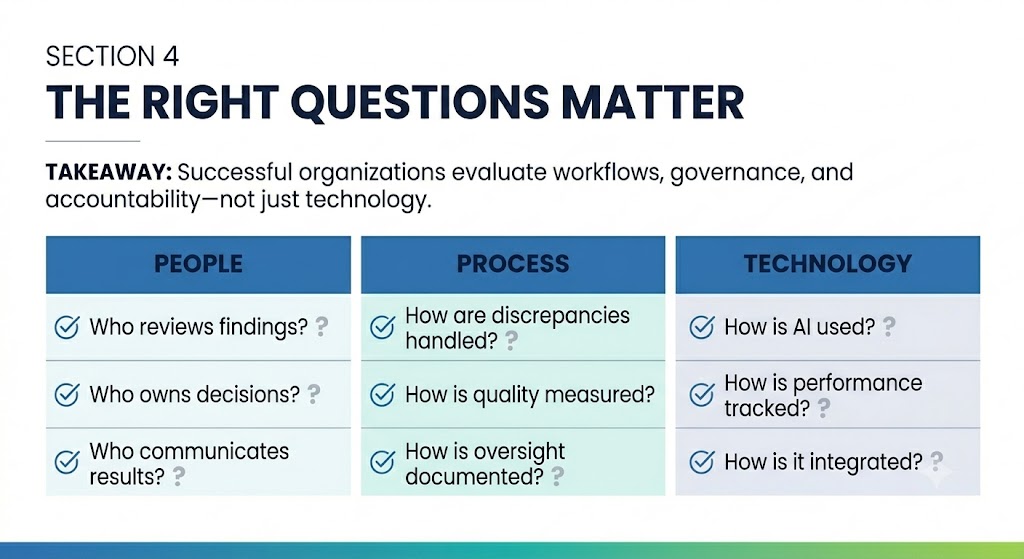
As AI becomes more common in imaging workflows, healthcare leaders should evaluate not only the technology itself, but also the systems surrounding it.
Organizations considering AI-assisted imaging should ask:
- How is AI being used within our workflow today?
- Who reviews AI-generated findings and recommendations?
- What happens when AI and a provider reach different conclusions?
- When are radiologists involved in the review process?
- Are discrepancies documented and tracked?
- Do we have written policies governing AI-assisted imaging workflows?
- How are imaging quality metrics measured and reported?
These questions may not generate headlines, but they often determine whether AI becomes a strategic advantage or an operational challenge.
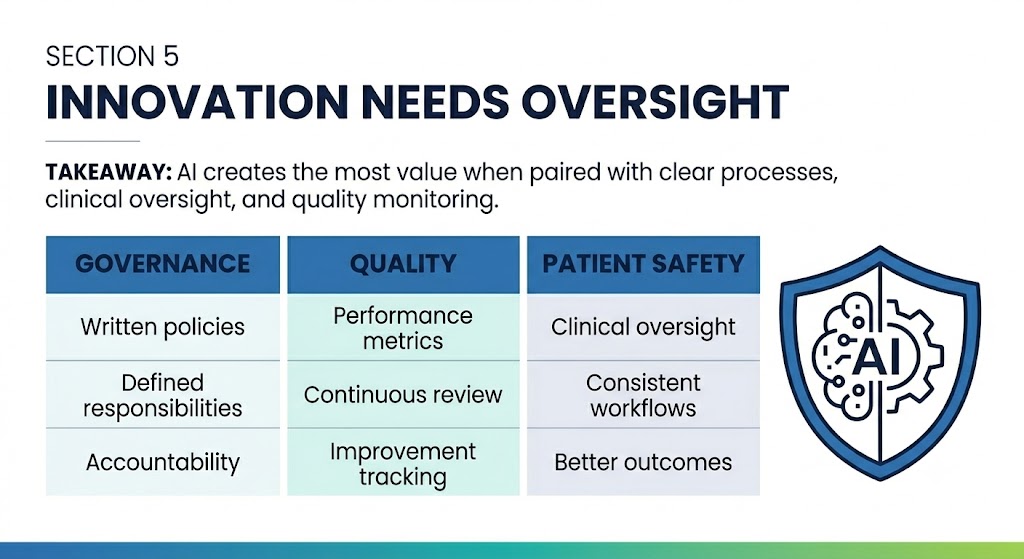
The organizations that benefit most from AI will not necessarily be those with the newest tools. They will be the ones that establish clear processes, strong oversight, and consistent accountability around how those tools are used.
The Questions Urgent Care Leaders Should be Asking Now
As AI becomes more common in imaging workflows, healthcare leaders should evaluate not only the technology itself, but also the systems surrounding it.
Organizations considering AI-assisted imaging should ask:
- How is AI being used within our workflow today?
- Who reviews AI-generated findings and recommendations?
- What happens when AI and a provider reach different conclusions?
- When are radiologists involved in the review process?
- Are discrepancies documented and tracked?
- Do we have written policies governing AI-assisted imaging workflows?
- How are imaging quality metrics measured and reported?
These questions may not generate headlines, but they often determine whether AI becomes a strategic advantage or an operational challenge.
The organizations that benefit most from AI will not necessarily be those with the newest tools. They will be the ones that establish clear processes, strong oversight, and consistent accountability around how those tools are used.
Related Resources

- Blog
← Back to Resources The AI Blind Spot: Why EMR and Practice Management Platforms Fell Behind in Revenue Cycle Innovation 09/10/2026 BlogAI, Revenue Cycle &

- Webinars

- Blog
← Back to Resources How to Change Urgent Care Technology Without Disrupting the Practice Urgent care clinics usually start evaluating a new EMR after months
Sign up to get monthly resources right to your inbox
Join more than 20,000 healthcare pros who score our free tips, tricks, guides, and the latest industry news.
By signing up, you agree to receive marketing emails from Experity and agree to our Privacy Policy. You can unsubscribe at any time.