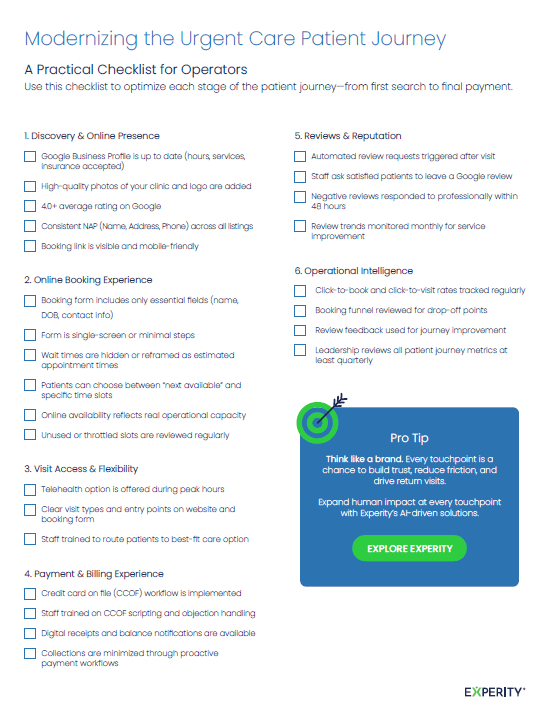
Patient experience in healthcare does not begin at check-in anymore.
It starts the moment a patient searches for care online.
They compare reviews. Check wait times. Decide whether scheduling feels easy or frustrating. Evaluate whether the experience looks modern, connected, and convenient before they ever walk through the clinic doors.
That shift was a major focus in a session at Experity’s Urgent Care Connect (UCC) event, where Jonathan Moss, EVP of Growth and Operations, Ian Lyman, SVP of Consumer Strategy and Innovation, and Kevin Clark, SVP of Strategic Partnerships, discussed how urgent care operators are redesigning the patient journey around access, convenience, and operational efficiency.
As Moss explained during the event, “Patients are becoming consumers, and they expect the same convenience and control they get from every other service in their lives.”
That expectation is reshaping what patient experience means in urgent care.
Today, the clinics creating the strongest patient experiences are not simply delivering quality care. They are reducing friction across every step of the journey, from search and scheduling to follow-up after the visit.
Patient Experience Starts Before the Visit
For years, healthcare organizations focused heavily on the in-clinic experience. But patients increasingly judge care long before they arrive.
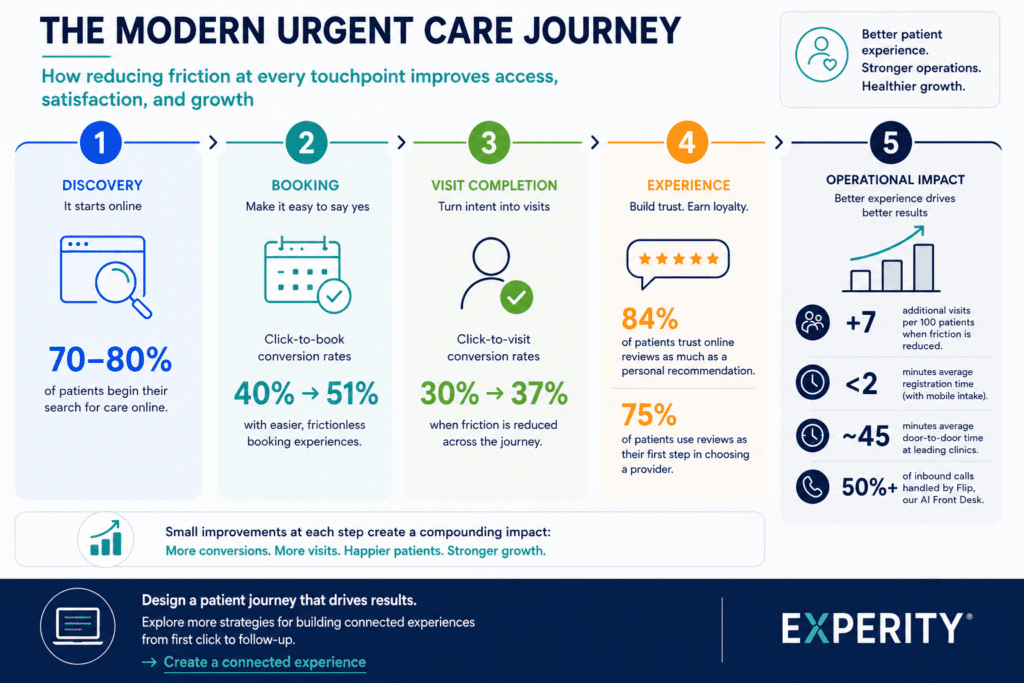
Industry data shared during UCC showed that 70–80% of patients begin their search for care online. That means patient experience now starts with:
- Search visibility
- Reviews
- Online scheduling
- Mobile usability
- Clear wait time expectations
- Ease of access
If those experiences feel difficult, confusing, or disconnected, patients often move on before booking at all. This is why the “digital front door” has become one of the most important operational and growth considerations in urgent care.
Learn more about the digital front door in The First Click Is the New Waiting Room >>
What the 38-Clinic Experiment Revealed About Patient Access
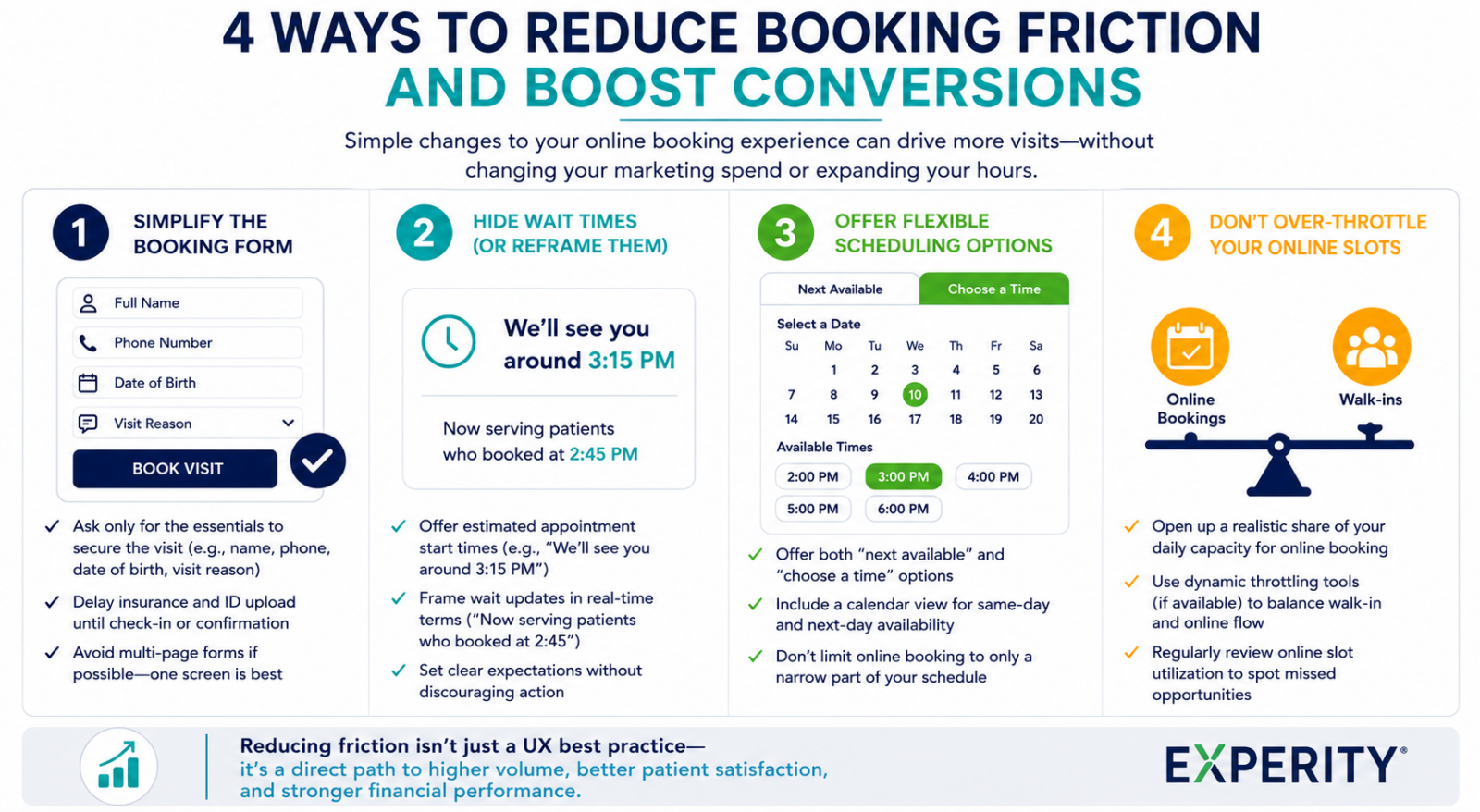
One of the most compelling examples shared at UCC came from a six-month experiment conducted across 38 urgent care clinics. The goal was simple: improve conversion throughout the online booking experience. Experity tested different configurations of:
- Form fields
- Appointment slot types
- Scheduling flow structure
- Visual design elements
The results were significant:
- Click-to-book rates increased from 40% to 51%
- Click-to-visit rates increased from 30% to 37%
That translates to seven additional visits per 100 patients without increasing marketing spend or expanding clinic hours.
The difference was not a larger advertising budget. It was less friction.
That finding reinforces an important shift happening across healthcare. Operational design decisions are increasingly shaping patient experience just as much as clinical care. Small moments matter:
- How easy scheduling feels
- Whether wait times are visible
- How quickly patients can complete intake
- Whether communication feels clear and timely
When those experiences improve, patient follow-through improves too.
Learn about The Hidden Cost of Missed Calls in Urgent Care and How to Fix It >>
Convenience Is Becoming a Competitive Advantage
Patients increasingly expect healthcare experiences to function like the digital experiences they use everywhere else. They want:
- Fast access
- Flexible scheduling
- Mobile-friendly experiences
- Digital communication
- Transparency throughout the visit process
At UCC, leaders emphasized that convenience is no longer a “nice-to-have” differentiator. It is becoming a core expectation. That includes virtual care access as well.
During the session, speakers shared that 45% of urgent care patients say they would prefer a virtual option when available. For urgent care operators, that means patient access is no longer limited to a single doorway.
The patient journey now includes:
- Search
- Scheduling
- Virtual access
- In-clinic workflows
- Follow-up communication
- Billing and payment experiences
Every step influences whether patients feel informed, supported, and confident in their care.
Reputation Is Built Across Every Interaction
One of the strongest themes across the UCC discussions was that reputation is no longer built solely through clinical outcomes. It is built through operational consistency. Patients remember:
- Whether calls were answered
- How long they waited
- Whether communication felt clear
- If scheduling was easy
- How connected the experience felt
Those moments shape trust. And trust increasingly shapes growth. Experity shared additional data at the event showing:
- 84% of patients trust online reviews as much as personal recommendations
- 75% use reviews as an early step in choosing care
As Kevin Clark noted during the event, “This isn’t about vanity. It’s about growth.” Reviews, communication, access, and follow-up are all part of the same patient experience ecosystem.
Dive further into reputation with Every Urgent Care Touchpoint Is a Reputation Moment >>