
The New Growth Equation for Urgent Care
How Midwest Express Clinic is turning patient experience into a driver of efficiency, collections, and scalable growth
Urgent care has spent the last decade focused on growth.
More locations. More patients. More services. The model has scaled quickly, fueled by demand for accessible, same-day care. But growth alone has not guaranteed success.
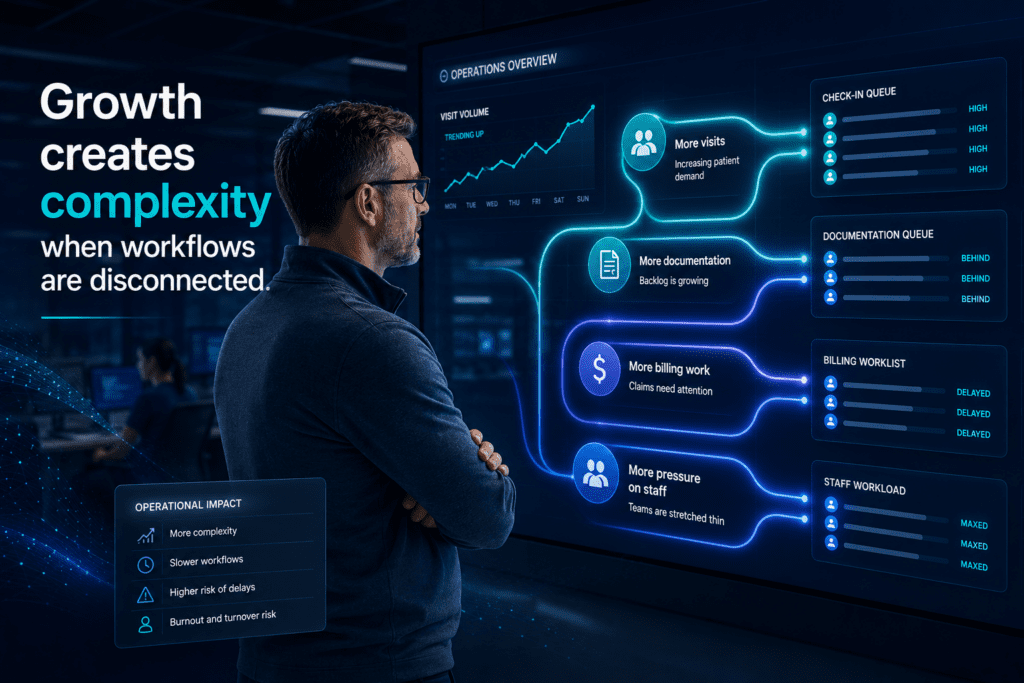
As operations expand, so does complexity. More visits create more documentation, more billing, more administrative work, and more pressure on staff. Over time, that complexity begins to erode margins, slow workflows, and create a more fragmented experience for patients.
The question many urgent care organizations are now facing is not how to grow.
It is how to grow profitably without compromising the experience that made urgent care successful in the first place.
At Midwest Express Clinic, that question is shaping how growth happens.
The Challenge
Growth Without Efficiency Breaks the Model
For many urgent care organizations, financial performance is tightly tied to operational efficiency.
Every breakdown in the workflow has downstream impact. Delays in documentation hold up billing. Friction in the payment process slows collections. Disconnected systems add unnecessary complexity that affects both operations and the patient experience.
Ryan VanHolsbeke, Director of FP&A at Midwest Express Clinic, has a clear view into those dynamics.
“On a day-to-day basis, I think I’m a numbers guy. I am not the medicine. I am the money individual… focused on reporting and providing data-driven insights to our clinicians and management team.”
From that vantage point, growth does not just increase volume. It exposes inefficiencies that are harder to manage at scale when workflows are not aligned.
It also raises a different question about technology. Not what a tool can do, but what friction it removes. Whether it helps patients navigate care more easily, allows providers to work more efficiently, and enables the organization to operate more effectively.
As volume rises, so do the consequences. Administrative burden increases, financial processes slow down, and patient expectations continue to climb.
That tension between scale and simplicity is where many organizations begin to struggle.
The Shift
Why Patient Experience Now Drives Growth
At Midwest Express Clinic, improving financial performance did not start with revenue cycle optimization alone. It started with the patient experience.
That connection is now central to how Ryan and his team evaluate technology investments. The question is not just how systems improve internal workflows, but how they make it easier for patients to navigate care before, during, and after the visit.
One of the biggest opportunities MEC identified sits outside the exam room. Patients often leave with instructions, results, and next steps, but accessing that information later is not always simple. Details are forgotten. Questions arise. Follow-up requires effort from both patients and clinic staff.
“Care Agent puts the patient at the forefront of the experience, providing readily on-demand information,” VanHolsbeke says.
By making that information readily available through a familiar, always-accessible channel, MEC is extending the care experience beyond the visit itself.
“Patients have their results on hand. They have their plan on hand. Even pharmaceutical information… readily accessible to them at any point in time.”
That access changes how patients engage with their care. They can reference instructions when they need them, better understand next steps, and stay aligned with their treatment plans without additional outreach.
At the same time, clinic teams spend less effort responding to routine questions or retrieving information that has already been provided.
What begins as a patient experience improvement creates benefits that extend far beyond the encounter. Better access reduces confusion, decreases follow-up effort, and improves how the organization operates. At MEC, that connection between experience and performance has become a guiding principle.

Application
Where Patient Experience Directly Drives Revenue
Payments are where the connection between patient experience and financial performance becomes measurable.
In many urgent care organizations, the process still relies on reminders, follow-ups, and manual outreach to drive collections. While those efforts can improve results, they also introduce additional work for staff and unnecessary friction for patients.
Midwest Express Clinic saw an opportunity to simplify that experience.
By implementing the payment skill through Care Agent, the goal was to make payments easier and more intuitive for patients, rather than relying on repeated follow-up to drive completion. The impact was immediate.
“The delivery of a simplified payments processing platform has resulted in a forty percent increase of dollars collected on a weekly basis pre- to post-Care Agent payment implementation,” VanHolsbeke says.
Patient participation increased alongside overall collections.
“Once an invoice is sent, we’re seeing a twenty percent uptake in the payment requiring less follow-up.”
That shift is important because it changes how collections improve. The results did not come from increasing outreach or adding more steps to the process. They came from removing friction.
“It really does enhance that patient experience,” VanHolsbeke says. “They’re not getting the first, second, and third text message reminding them to make a payment.”
For patients, the process becomes straightforward and less intrusive. For staff, time spent managing reminders and follow-up decreases. For the organization, revenue becomes more predictable.
The outcome reflects a broader pattern. When the experience is easier for patients, collections improve, follow-up decreases, and operational efficiency follows.
While patient engagement and payments influence performance outside the exam room, provider efficiency remains one of the most important factors shaping results inside the clinic.
The delivery of a simplified payments processing platform has resulted in a forty percent increase of dollars collected on a weekly basis pre- to post-Care Agent payment implementation. Once an invoice is sent, we’re seeing a twenty percent uptake in the payment requiring less follow-up.”
Ryan VanHolsbeke, Director of FP&A at Midwest Express Clinic
Application
Improving the Visit Experience for Both Patients and Providers
Documentation has long been one of the biggest constraints in urgent care operations.
At MEC, AI Scribe is directly addressing that bottleneck.
“We actually had a provider see fifty-four patients in a single day using AI Scribe, and not a single chart was left open.”
That outcome has immediate implications across the organization.
“Open charts can result in poor customer service, can delay billing, can delay collections… seeing that many patients and having all of them closed by the time that provider walked out the door is a win for everyone.”
When documentation is completed in real time:
- Billing cycles begin faster
- Revenue is captured without delay
- Providers avoid after-hours charting
- Staff are not chasing incomplete work
Documentation, billing, and revenue capture begin to move in sync.

Application
Connecting These Gains Across a Single System
What MEC is building is not a collection of isolated improvements. It is a connected system where each part of the care journey reinforces the others.
Historically, urgent care organizations have measured patient experience, operational efficiency, and financial performance separately. MEC’s experience suggests that approach is incomplete. Improvements in one area create measurable benefits in the others.
This is where platforms like Experity play a central role.
Rather than solving documentation, payments, and patient engagement separately, Experity connects them within a unified urgent care operating system. AI Scribe, Care Agent, and integrated revenue cycle tools work together to reduce friction while keeping clinical workflows and financial outcomes aligned.
Patients move through the experience with fewer barriers. Providers spend less time on administrative work. Financial processes are triggered faster and align more closely with care delivery.
That alignment is what allows organizations like MEC to grow without introducing additional complexity.
Growth becomes less about optimizing individual metrics and more about strengthening the connections between them.
The Results
The Outcome: Better Performance Without Added Burden
As these systems come together, the impact shows up in both operational performance and the day-to-day experience:
- 40% increase in weekly dollars collected and 20% higher payment uptake after invoices are sent, driven by simplified payment workflows
- 54 patients seen in a single day with AI Scribe, with every chart completed before the provider left, eliminating downstream delays in billing and collections
- No end-of-day chart backlog, reducing administrative carryover and accelerating revenue cycle timing
- On-demand access to discharge instructions, results, and care plans, giving patients clearer visibility into their care without additional follow-up
Equally important are the qualitative improvements.
Patients receive clearer information with fewer interruptions after their visit. Providers can complete their work within scheduled hours. Staff spend less time managing manual processes.
The Results
A New Standard for Urgent Care Growth
Demand for urgent care continues to rise, and growth remains a priority for most organizations.
What is changing is how success is defined.
Growth without efficiency creates operational strain. Efficiency without experience limits patient engagement. Sustainable performance requires both.
MEC’s approach reflects a new model for urgent care.
By using AI to reduce friction across the entire care journey, they are aligning patient experience, operational efficiency, and financial performance into a single, connected system.
The result is a different kind of growth. One that simplifies the experience for patients, supports providers, and strengthens financial outcomes at the same time.
In urgent care, that balance is the new equation for success.

Ready to Build a Better Growth Engine?
Midwest Express Clinic improved collections, accelerated documentation, enhanced the patient experience, and reduced administrative burden by connecting every stage of the care journey.
Discover how Experity helps urgent care organizations deliver measurable operational and financial results through one unified platform.