Imaging programs rarely stay the same for long. New providers join the team. Clinics expand. Patient volumes increase. Technology evolves. Processes that once worked naturally become harder to sustain across a larger organization.
This is the challenge imaging maturity is designed to address. A mature imaging program delivers reliable outcomes despite changing providers, growing patient volumes, and expanding operations. Turnaround times, discrepancy rates, and provider satisfaction all provide valuable insight, but they reveal only part of the picture. The capabilities that produce those results often explain why some organizations continue improving while others struggle to scale.
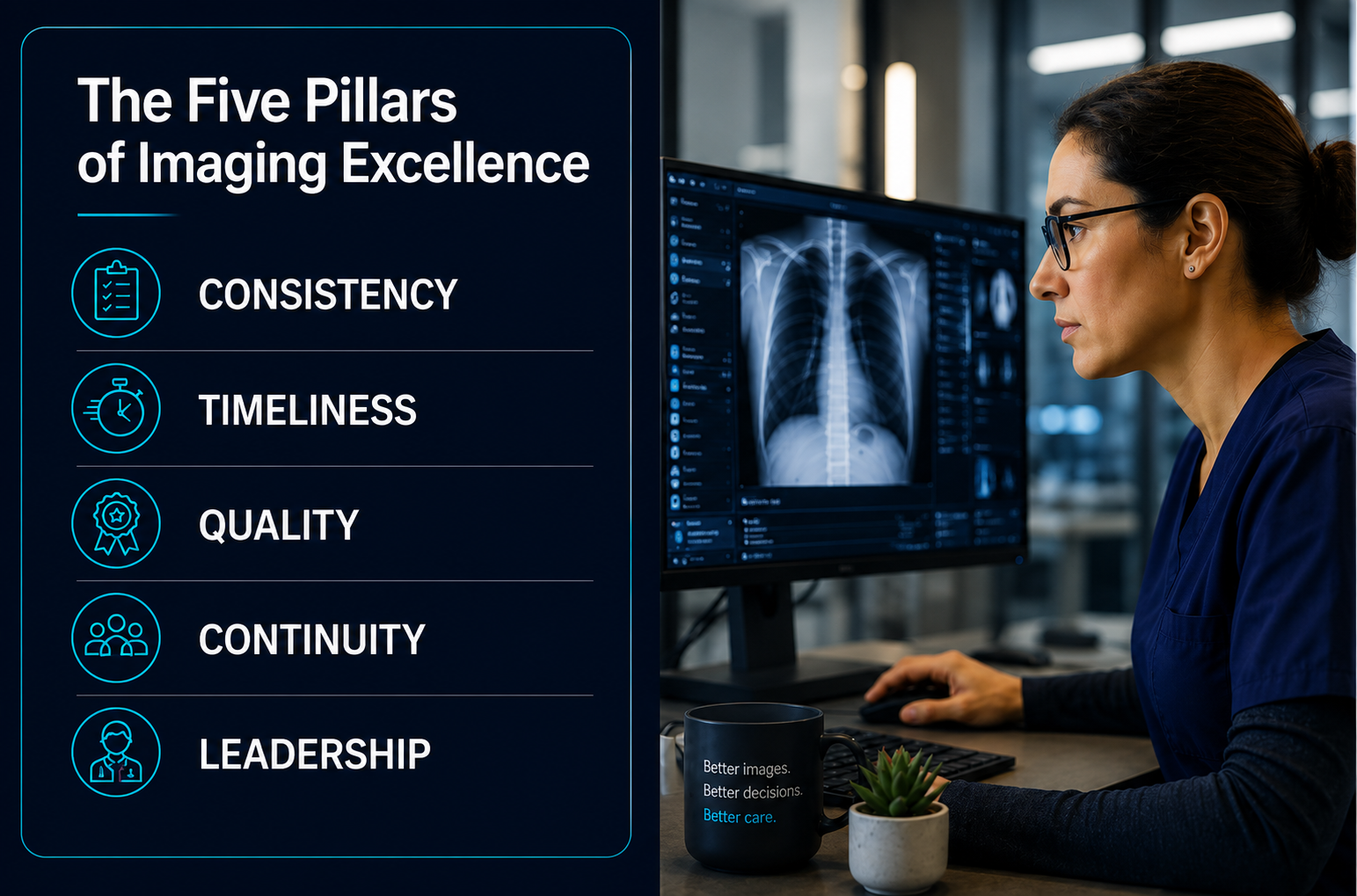
Through Experity’s work with urgent care organizations, we’ve found that the strongest imaging programs share five foundational capabilities. Together, they form what we call the Five Pillars of Imaging Excellence:
- Consistency — Delivering the same dependable imaging experience across providers, clinics, and patient encounters
- Timeliness — Moving imaging efficiently from acquisition to clinical decision without unnecessary delays
- Quality — Strengthening diagnostic performance through collaboration, feedback, and continuous learning
- Continuity — Ensuring patients receive timely communication, follow-up, and coordinated care after imaging
- Leadership — Managing imaging as a strategic operational capability rather than a collection of individual reads
No organization is equally mature across every pillar. Most imaging programs have clear strengths, along with opportunities to improve as patient volumes grow, technology evolves, and operational complexity increases.
The five questions below provide a practical way to evaluate your imaging program through the lens of these pillars. Use them to identify strengths, uncover opportunities, and focus future improvement efforts.
Pillar 1: Consistency
Question: Is Every Study Supported by a Consistent Review Process?
Urgent care providers make treatment decisions quickly, often while the patient is still in the clinic. Initial X-ray interpretation is part of that reality. The consistency of the review process determines whether that initial interpretation becomes part of a reliable imaging program or remains an isolated clinical decision.
Some organizations have a standardized review process for every study. Others rely on provider discretion or only request overreads in certain situations. Neither approach is inherently right or wrong, but consistency matters. A defined process helps ensure patients receive the same level of review regardless of which provider is working, what day of the week it is, or which clinic they visit.
Consistency also creates confidence for providers. When every study follows the same path from image acquisition to final interpretation, clinicians spend less time wondering whether an overread will arrive or whether follow-up will be required. Instead, they can focus on treating patients while knowing the imaging process is working consistently behind the scenes.
Pillar 2: Timeliness
Question: Can Your Workflow Keep Pace With Patient Demand?
Fast turnaround times are important, but averages can conceal meaningful variation. Many imaging programs perform well during routine clinic hours yet struggle during evenings, weekends, or periods of unexpectedly high patient volume. Those fluctuations affect providers when timely radiologist support is often needed most. A workflow that performs well at 10 a.m. but slows significantly during the evening rush can quickly become a bottleneck for patient care.
Rather than focusing only on average turnaround times, consider whether your workflow consistently supports patient care throughout the week. Are studies moving efficiently from acquisition to interpretation? Do providers know when to expect final reads? Are patients receiving timely follow-up when additional findings are identified?
Timeliness creates value because it reduces uncertainty for everyone involved. Providers know when to expect a final interpretation. Patients receive answers before leaving the clinic whenever possible. Operational leaders can forecast staffing needs and identify bottlenecks before they affect throughput. Reliable turnaround times become part of the clinic’s operating rhythm rather than a pleasant surprise.
“If your imaging is fast and reliable, it becomes a market differentiator and a competitive edge.”
— Dr. Ron Boucher, Chief Medical Officer, Teleradiology, Experity, “Teleradiology as a Competitive Edge: Elevating Urgent Care Through Faster, Smarter Imaging”
Organizations built for scale deliver dependable turnaround times because imaging workflows have been designed to perform consistently under pressure.
Pillar 3: Quality
Question: Does Every Overread Make Your Program Better?
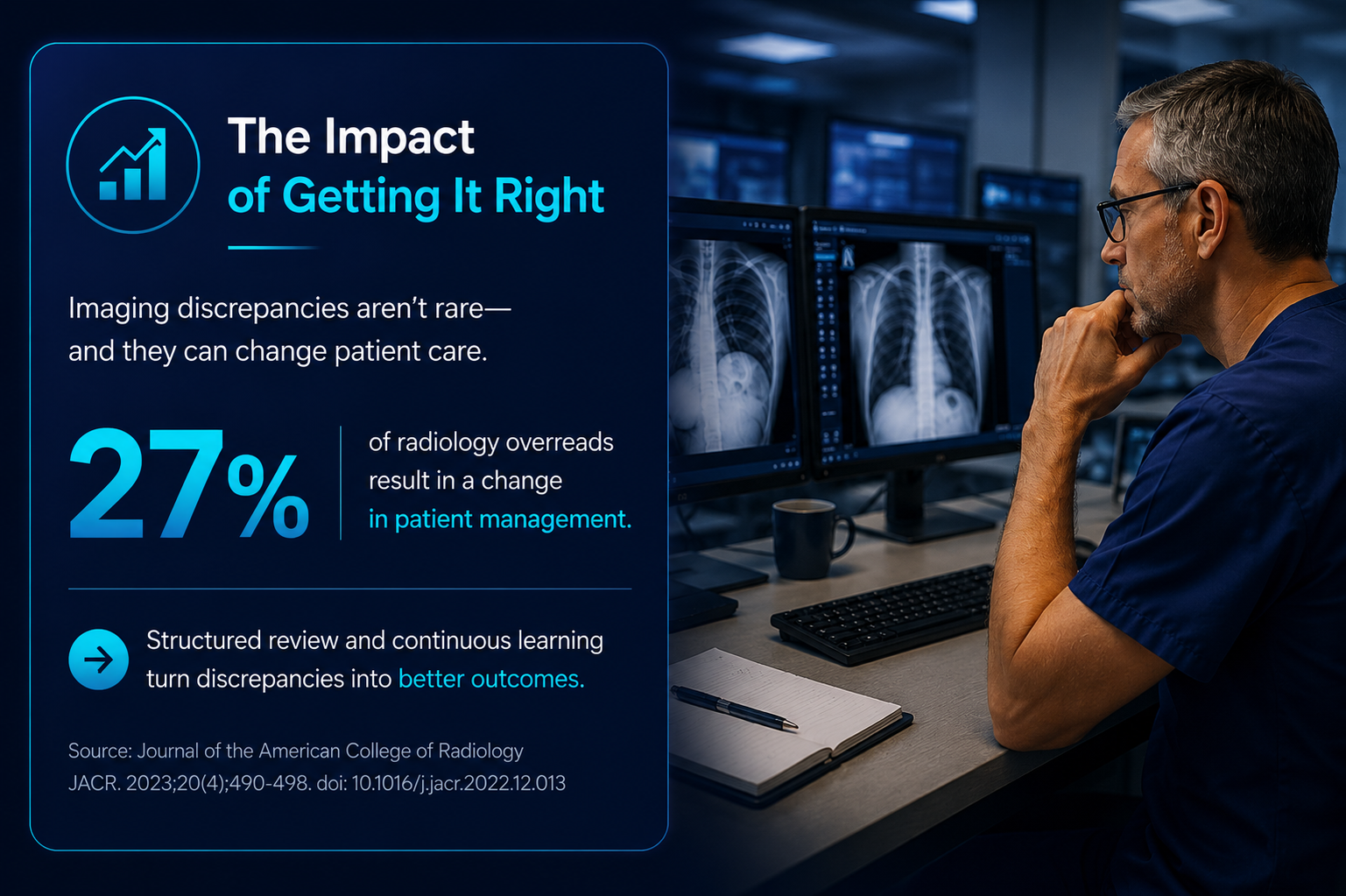
Every imaging program experiences differences between an initial interpretation and a radiologist overread. Some affect patient management, others do not, but every discrepancy provides information about how the imaging program is performing. Research has shown that clinically significant discrepancies can change patient management, reinforcing why leading organizations treat overreads as more than a safety net. They use them to strengthen provider education, improve workflows, and identify opportunities for continuous improvement.
Organizations with solid imaging programs view every overread as an opportunity to strengthen the system. Individual cases become part of a larger learning process that helps identify recurring patterns, improve provider confidence, refine workflows, and strengthen communication between providers and radiologists. Every overread adds another opportunity to improve the next patient encounter.
That collaborative mindset surfaced repeatedly during the 2026 UCC discussions on imaging operations. Several conversations centered on what should happen when an imaging report and a provider’s clinical assessment pointed in different directions. The consensus was clear: share clinical context, ask questions, and work together to reach the best decision for the patient.
Organizations that encourage this type of collaboration create an environment where providers gain confidence, radiologists receive more meaningful clinical information, and quality improvement becomes part of everyday operations instead of an occasional review process.
As Dr. Boucher summarized, “Treat the patient, not the X-ray.”
This advice captures the collaborative nature of imaging. Providers understand the patient’s history, symptoms, and physical exam. Radiologists bring deep expertise in image interpretation. When those perspectives come together through a well-designed workflow, patients benefit from a more complete clinical picture.
Pillar 4: Continuity
Question: Does Every Patient Receive Timely Follow-Up?
An imaging workflow doesn’t end when the radiologist signs the report. If a final interpretation differs from the initial read, patients need to be notified, care plans may need to change, and follow-up should happen as quickly as possible. Having a documented process helps ensure those conversations occur consistently instead of depending on individual memory or manual workarounds.
Continuity is measured by what happens next. Patients shouldn’t have to wonder whether anyone reviewed the final report or whether additional findings will change their care. A dependable follow-up process closes the loop between imaging, clinical decision-making, and patient communication so that important information reaches the right person at the right time.
When organizations consistently close that loop, they strengthen more than patient care. Providers have greater confidence in the imaging process, leaders gain clearer visibility into workflow performance, and patients leave knowing their care continues beyond the visit if new information emerges.
Pillar 5: Leadership
Question: Are You Building a Program or Managing Individual Reads?
Many imaging programs evolve gradually over time. New providers join the organization. Patient volumes increase. Workflows adapt. New technologies are introduced. Without regular evaluation, it’s easy to focus on individual cases while losing sight of the overall program.
High-performing organizations regularly review imaging quality, discuss trends, gather provider feedback, and look for opportunities to strengthen processes. They don’t wait until a problem forces the conversation. They build continuous improvement into the way the program operates.
Perhaps most importantly, they view imaging as an operational capability rather than simply a diagnostic service. Workflow design, quality assurance, provider collaboration, communication, and continuous evaluation all work together to improve patient throughput, provider confidence, and long-term consistency.
That’s often the biggest difference between organizations that simply perform imaging and those that have built a mature imaging program.
Imaging Excellence Is Built One Pillar at a Time
Every imaging program has strengths, and every program has opportunities to improve. Sustainable progress depends on strengthening the capabilities that support every imaging encounter, allowing each improvement to reinforce the next.
The Five Pillars of Imaging Excellence provide a framework for that work. Together, they help leaders evaluate how imaging is managed, where opportunities exist, and how today’s improvements create a stronger foundation for tomorrow.
Building a mature imaging program starts with understanding where you are today. Learn how Experity Teleradiology helps urgent care organizations strengthen workflows, support providers, and deliver more consistent imaging quality.