Pillar 5: Leadership
Imaging can appear well managed when the individual pieces are performing as expected. Reports are coming back, turnaround times are being monitored, discrepancies are being reviewed, and providers have access to support during busy clinic hours. For many urgent care organizations, that level of operational control keeps daily work moving.
Imaging, however, now influences far more than the clinical encounter. It affects patient throughput, provider confidence, quality improvement, staffing decisions, technology investments, and an organization’s ability to scale consistently across locations. Understanding how those priorities connect is what transforms imaging from an operational function into a strategic capability.
That is what the leadership pillar is designed to measure. Strong leadership gives structure to the rest of the Imaging Excellence Framework by helping organizations identify priorities, understand where variation exists, and align imaging performance with broader business goals.
Ultimately, leadership determines whether an imaging program can be measured, improved, and scaled with intention.
High-Performing Imaging Programs Are Designed Over Time
Imaging programs rarely become mature through a single decision. They take shape through hundreds of choices made as clinics expand, patient volumes increase, providers join the team, technology changes, and operational needs evolve. Some of those choices are made deliberately. Others happen quietly because a local team found a way to solve an immediate problem.
That gradual evolution is normal, but it often leaves leadership with a difficult question: Is the imaging program operating the way the organization intended, or simply the way it has evolved over time? Without a shared strategy, today’s workflows become tomorrow’s operating model, making it difficult to know whether performance reflects deliberate design or years of incremental decisions.
Leadership brings intentional design to that evolution. It establishes the standards, priorities, and review processes that help imaging mature as the organization grows. The goal is to create an operating model that can support today’s patient volume while preparing the organization for the next stage of growth.
That kind of design extends beyond policies. Leaders shape how providers receive support, how quality trends are reviewed, how technology is evaluated, how communication pathways function, and how follow-up responsibilities are carried through to completion. Mature programs emerge when those decisions work together.
Visibility Has to Extend Across the Entire Program
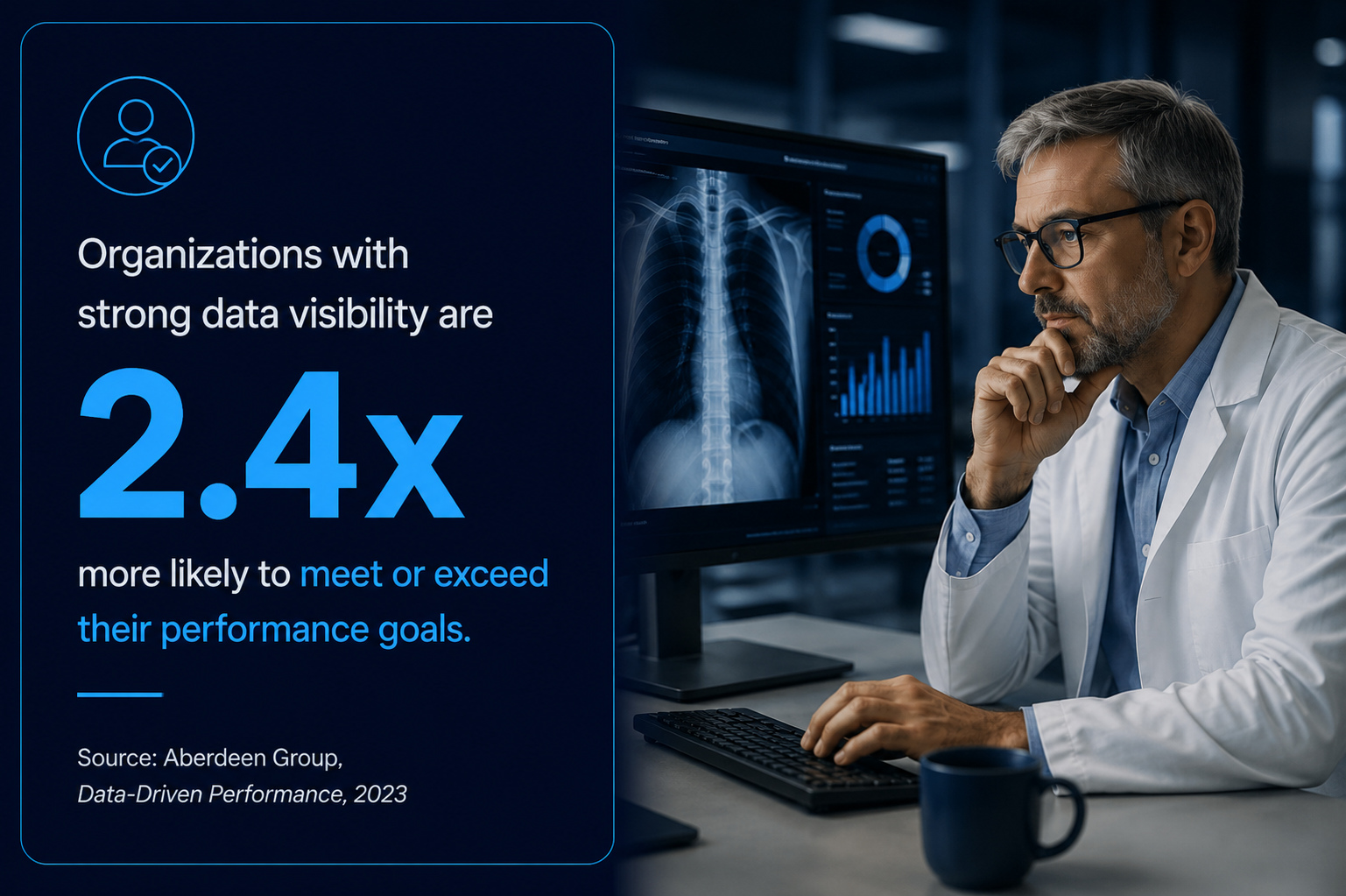
Visibility becomes more challenging as organizations grow. More clinics, providers, and imaging studies generate more information, but not necessarily more clarity. Leadership requires a view of the program that reveals relationships, patterns, and emerging risks rather than isolated operational results.
Imaging performance is cumulative. A delay in one part of the workflow can influence provider efficiency, patient throughput, patient experience, and the amount of work that occurs after the visit. Looking at those outcomes independently often hides the broader operational pattern.
That level of visibility helps leaders ask better questions. Which clinics consistently receive interpretations while patients are still in the visit? Where does variation appear between routine hours and peak demand? How often do final findings require additional action after discharge? Are providers receiving the same level of support across locations? Which issues appear repeatedly enough to require program-level attention?
Those questions move imaging leadership beyond performance monitoring. They help organizations understand whether the program is functioning as a connected system.
Strategy Emerges When Leaders Connect the Signals
Every organization collects operational data. Leadership creates value by interpreting what that information means collectively rather than individually. The goal is not to monitor each measure in isolation, but to understand how performance in one area influences the rest of the imaging program.
The previous pillars each reveal something important about organizational performance. Consistency reflects how reliably standards are applied. Timeliness reveals whether imaging supports clinical decision-making when it matters most. Quality demonstrates whether the organization is learning from its work. Continuity shows whether important findings reliably reach the patient and result in appropriate action.
Leadership connects those signals.
Taken together, they provide a more complete picture than any single metric can offer. A trend that appears operational on the surface may point to broader questions about workflow design, staffing, technology, communication, or organizational priorities. Looking across the pillars helps leaders identify the underlying issue rather than reacting to individual symptoms.
That perspective makes prioritization more effective. Organizations can focus on the capability most likely to strengthen overall performance instead of pursuing isolated improvements that produce only incremental gains.
Technology Scales the Strategy You Already Have
Technology plays an increasingly important role in imaging operations. AI, workflow automation, integrated communication tools, enterprise imaging platforms, and performance dashboards all have the potential to strengthen how organizations acquire, interpret, communicate, and act on imaging information.
The effectiveness of those tools depends heavily on leadership clarity.
When operating goals are unclear, technology can make existing variation more visible without resolving it. A new platform may accelerate a workflow that still lacks consistent ownership. Automation may make tasks faster while preserving process gaps. Dashboards may provide more data than leaders can meaningfully use because the organization has not agreed on which questions matter most.
Clear strategy changes the way technology is evaluated. Leaders can assess whether a tool helps reduce variation across locations, supports faster clinical decision-making, improves quality visibility, strengthens follow-up, or gives leadership a clearer view of program performance. The conversation shifts from what the technology can do to whether it helps the organization build the imaging program it needs.
That is where leadership creates leverage. Technology becomes more valuable when it supports an operating model that has already been designed with intention.
Leadership Builds a Program That Can Adapt
One of the clearest indicators of an imaging program’s maturity is how well it performs when conditions change. Growth introduces new clinics, new providers, changing patient volumes, evolving technologies, and new operational priorities. Each change places additional demands on the systems supporting imaging.
Organizations with strong leadership adapt without rebuilding the program every time circumstances change. Shared standards provide stability, performance measures reveal where adjustments are needed, and governance creates a consistent process for evaluating new opportunities. The program evolves without losing the consistency and reliability that providers depend on every day.
That adaptability becomes increasingly valuable as urgent care organizations expand. Leadership teams are no longer making decisions solely for today’s operations. They are building an imaging program capable of supporting tomorrow’s organization.
Viewed through that lens, leadership becomes an investment in resilience. It gives organizations confidence that imaging can continue supporting clinical care, operational performance, and future growth even as the environment around it changes.
Where Does Your Imaging Program Stand?
Throughout this series, we’ve challenged several common assumptions about imaging performance. Consistency is more than standardization. Timeliness is more than turnaround speed. Quality extends beyond overreads. Continuity requires more than patient follow-up. Leadership brings those ideas together into a practical framework for evaluating, improving, and scaling an imaging program.
A mature imaging program is measured, reviewed, improved, and aligned to the organization’s broader goals. It gives leaders confidence that imaging supports daily clinical decisions while also strengthening patient experience, operational efficiency, and long-term growth.
That kind of program does not emerge from activity alone. It requires intentional leadership.
Build a Stronger Imaging Program
Experity Teleradiology helps urgent care organizations strengthen imaging performance with reliable access to radiologist interpretations, connected workflows, and the visibility needed to support quality, consistency, and growth across locations.
See how Experity can help you build an imaging program that supports both daily clinical decisions and long-term operational goals.